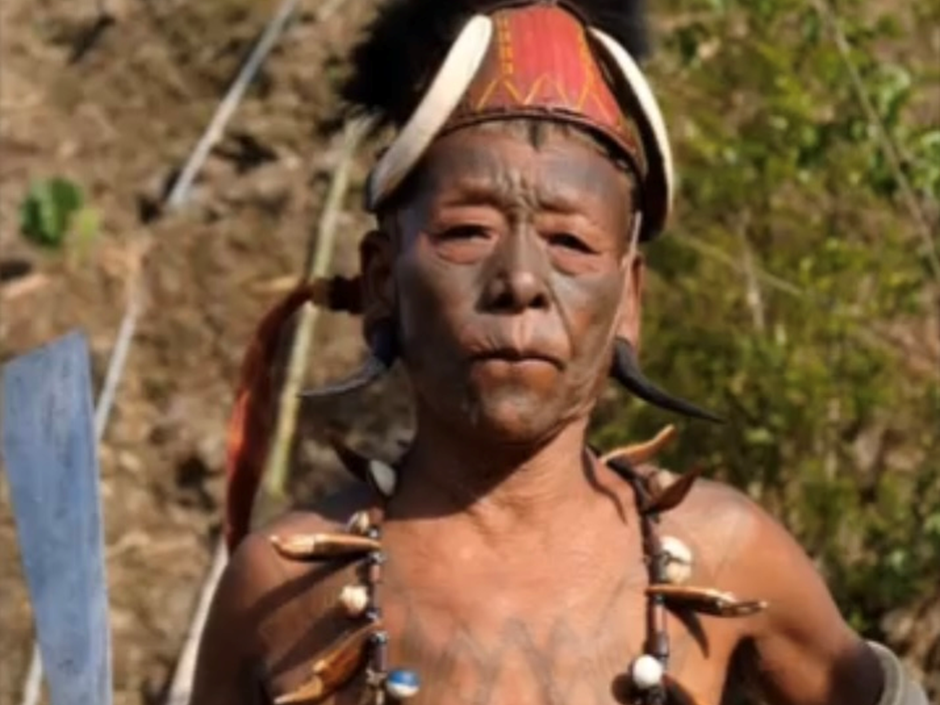
‘This is an antler from the deer I first hunted’ he said pointing at his ear piercings.
I took a minivan from Kohima, Nagaland’s capital to Dimapur, the largest city in the state. I found myself at Golaghat road, amidst a lane lined up with transportation offices with colorful boards that listed every town they ply to. I knocked every office counter asking for a ticket to Mon village, only to hear they were fully booked out due to Christmas Eve. I slapped my forehead in despair, questioning if this was the end of my meeting the tattooed headhunters tribe, the Konyaks.
I walked away head bent down, but a voice called from behind, ‘There is a makeshift seat beside the driver. Will you take it?’ Anything was worth trading at that moment. A smile escaped my lips, I nodded in agreement.
In the wee hours of 3 am, the bus came to a stop at Mon Village, passing through roads that tested the strength of my spine. Directed by a local, I walked to a shop made of bamboo at the end of the road from where I could get a ticket to Longwa, the final destination.
Putting the backpack aside, I sat at the side of the road, with only Christmas lights decorated in shapes of fairies, Santa and stars to company. Two hours later, a man walked up to me asking what a lone girl was doing there. Startled, I spoke in mono syllables. When he heard ‘Longwa’, he said what I dreaded the most, ‘Christmas holidays, no tickets.’ While I sat there puzzled, he made a quick phone call speaking in Nagamese, that I barely understood.
The words I heard next, felt like music to my ears. ‘I spoke to my sister, requested her to arrange a ticket for you. Don’t worry.’ Thanking him, I broke out into a conversation, acknowledging he was there to help and didn’t mean any harm. He told me about the King’s house in Longwa, and bits of history of the Konyak Tribe.
As dawn set in, people went about their daily chores, Alex typed his phone number assuring I could ring him if I were in trouble, and walked away. An hour later, a jeep arrived, covered in dust. He called out the ticket numbers, I followed tugging my backpack. Bumping along rickety roads, I could finally see a board that read Longwa. I sighed in relief! It was 18 hours since I started my journey from Dimapur. I was greeted by my host, Alem, who led the way.
Curious locals asked her where I was from, and how I managed to come alone as a woman, to their village on the India-Myanmar Border. She walked me through the entrance lined with shops selling goods bought mostly from the other side of the border.
Hiking up a rocky path, she led me to Traveller’s Inn, a homestay she and her brothers were looking after. Before we entered, she pointed to a house covered in conical shaped roof of red brick, ‘That’s the King’s house, the India-Myanmar border runs through his house!’
‘Can we go there now?’ I asked brimming with excitement of being able to stand in two countries at once. ‘Freshen up, we will meet the headhunters first. A popular Youtuber has also come.’ She seemed rather excited to meet the Youtuber’s team and so was the village, but my heart fluttered hearing ‘headhunters’. After all, I braved the long way to Longwa to meet them.
A quick shower, and throwing my backpack on the bed, we hurried to the house where everyone had gathered. The wall at the entrance was decked with animal heads that were hunted years ago. Bending my head down, I entered inside, but saw a professional camera setup. ‘It’s them’ Alem squealed in excitement and hurried to get photos clicked with them. She came back smiling, ‘These are the people from the ‘Best Ever Food Review Show,’ and showed me clips on her phone.
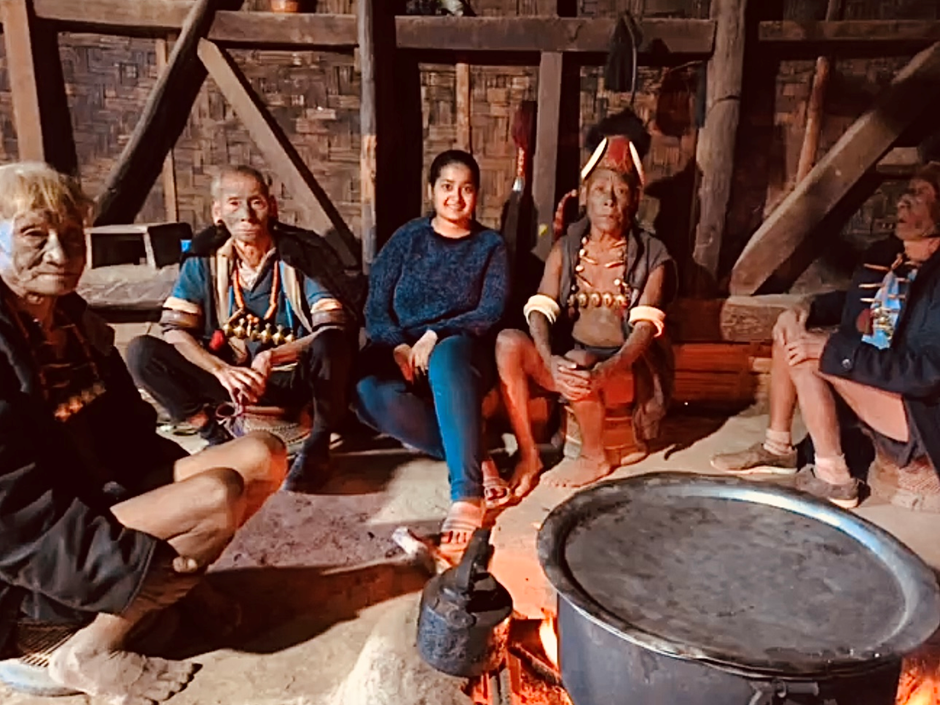
I turned to my left and saw the Konyaks, the last surviving tattooed headhunters. In a constant state of jaw drop, I sat among them. Over a boiling pot of pork being cooked, they chatted away amongst themselves like officers discussing a new clue in a murder mystery. Seeing a puzzled face, Alem translated that for me, saying they were talking about how much their lives have changed and the circumstances too.
Minutes later, the team took a break to enjoy the feast the local family had made. With a variety of dishes that exceeded finger count, everyone rushed to the table that was atleast a meter long. Because I don’t eat meat, I sat on the side, wondering what the Konyaks’ story was.
I finally got talking to a couple of them, of course with translation, else I wouldn’t be writing this story. Before I could ask, he said, ‘This is an antler from the deer I first hunted’ pointing at his ear piercings.
‘What did headhunting feel like to you?’
‘A tradition, it was passed down to us by our ancestors.’ He continued, ‘Head (the skull) has the soul force of a human. We believed hunting and hanging the heads at our house, brought prosperity to our village.’
‘Sometimes we killed to avenge the death of our loved ones.’
With the arrival of Christian missionaries, and them advocating against it, this headhunting practice came to a stop, I later learnt from my host.
I then asked ‘Do you miss headhunting now?’
With strangeness in his eyes he replied, ‘No, after listening to them and adopting it. I wish Christ forgives me for what I’ve done.’
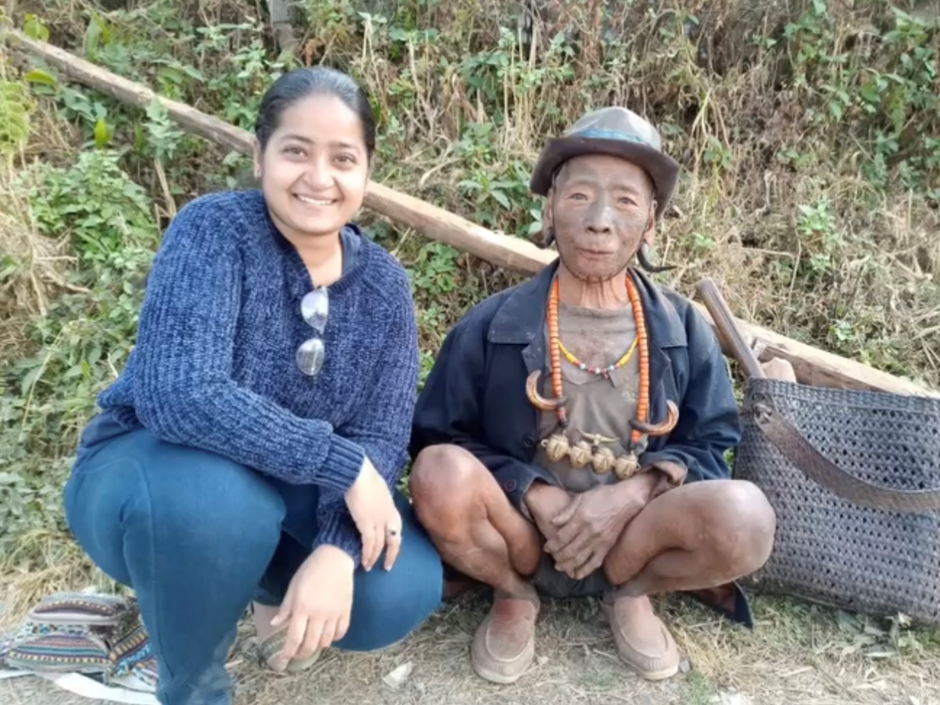
Feeling like a scientist making a new discovery, I traced my footsteps back to the homestay, not without clicking photos with them.
Sipping Burmese Coffee, my co-host Namhei brewed for me, I looked at the sun sinking below the horizon. My thoughts kept going back to what I witnessed – the journey of the headhunters. The cold winter breeze was getting to my bones, I made my way inside. He was setting up the bonfire in the kitchen. As the fire started to fill the room with warmth, I shot him questions that were racing through my mind, with a curios look on my face. He spoke in intervals, adjusting the logs. Here’s what I learned from that conversation, and has stayed with me since.
Headhunting was a symbol of power, and put the Konyaks at a place of dominance amongst other tribal groups. They were respected and feared for their warrior skills. Young boys were taught warfare skills at the Morung, a traditional educational institution which unfortunately is now fading. Naga elders passed down knowledge about the tribe’s customs, traditions, religious practices, and also equipped them with skills like bamboo weaving, wood carving and more.
The belief of headhunting was rooted in the thought that the head had soul force, killing that brought fertility to their lands, and ensured well-being of their families and the village. They mostly hunted due to wars with other tribes, but sometimes as a dedication to a new village settlement. It doesn’t stop there. They belief deepens to the point that they thought, by severing the head they secured the victim as a slave in their afterlife.
The severed heads were brought with a feeling of triumph, later handed them to the Angh (chief). While animal heads were hung at their respective houses, human heads were hung only at the Angh’s house.
Each headhunting victory got the men a tattoo – it was like having educational degrees; the more the better. It was also done for purification after headhunting, to stop the ill luck of the victim by shedding a bit of their own blood. Only the Anghya, the chief’s wife could tattoo them. Young boys got tattoos as a sign of coming of age, and women got tattoos that indicated their progression in life. They also blackened their teeth, believing it enhanced their appeal. And here we are years later, thinking black is not beautiful.
Though the government banned the practice in 1960s, they went about it without anybody whiffing it. But the Christian Missionaries arrival is 1970s changed the face of this tradition forever. More people adopted the faith, and gave up the practice. It is now, one for the books!
As I was collecting my thoughts, he served me a plate of Nagaland’s traditional steamed sticky rice with dal (lentils), which I relished to the last bite. I slept gazing stars outside the window, which was rare for a girl who came from a city where not stars, but buildings touch the sky.
I woke up the next morning, when light hit my face through the window curtains. He then took me to the King’s house. I entered the house at the Indian side, took a quick tour and met the King in Myanmar. After I stepped away, he went back to a serious discussion with the other village chiefs. ‘One foot here, One foot there’ I jumped, looking at the boards indicating both country names on either side of the entrance.
He took me on a little village tour, showing off proudly the border stone written in both Burmese and Hindi, the Zero Point, and the Army cantonment. We returned in the evening, to another cup of Burmese coffee.
Sitting alone at night, I smiled to myself thinking I lived a piece of history, witnessed it before it vanishes forever.
I packed my bags, and came down to the ticket counter. As the vehicle set off, they waved me goodbye, ‘Come back for the Aoling Festival!’
The roads back home were the same, but I wasn’t.


Leave a Reply